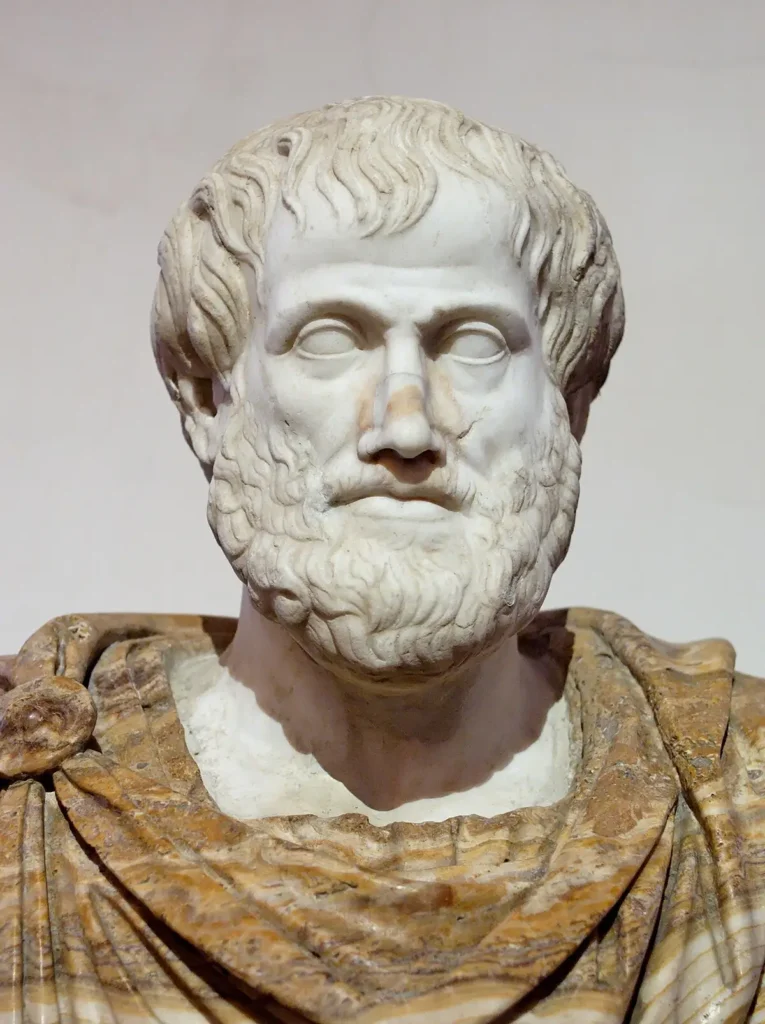
Aristotle, one of the greatest philosophers in history, is considered one of the most prominent thinkers of Western philosophy. He was born in 384 BC in the city of Stagira in Macedonia (northern Greece), and died in 322 BC. A disciple of Plato, he became a teacher of Alexander the Great and helped lay the foundations of many fields of thought, including philosophy, logic, the natural sciences, politics, and ethics.
Growing up and educating
Childhood and family:
- Aristotle was born into a medical family; his father Nicomachus was a physician to King Amyntas III, which made him familiar with science from a young age.
- He lost his parents at an early age, and a relative took care of him.
Education:
- At the age of seventeen, he moved to Athens to join Plato’s Academy, where he spent twenty years studying philosophy and science.
- He was influenced by Plato’s philosophy, but later disagreed with him on several concepts, such as the theory of ideals.
Teaching:
- After Plato’s death, Aristotle moved to Asia Minor, then returned to Macedonia to become a teacher of Alexander the Great.
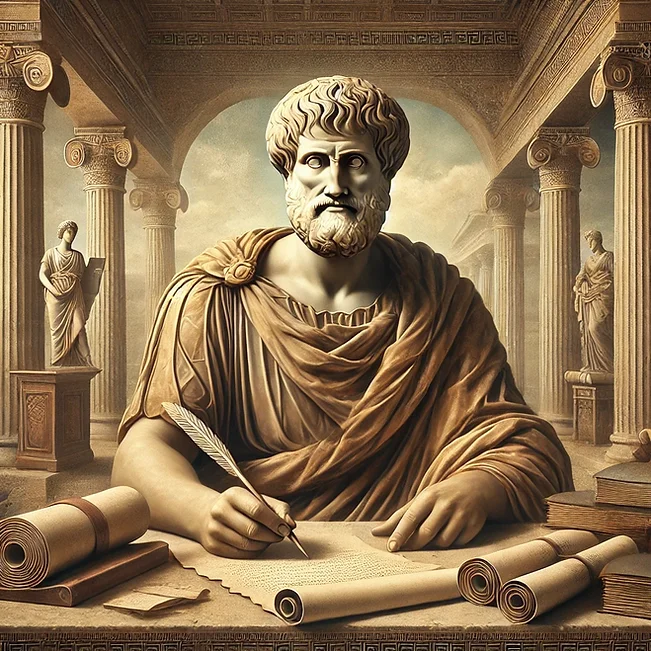
- In 335 BC, he founded the Lyceum in Athens, where he studied and wrote most of his works.
Philosophy and ideas
1. Logic:
- Aristotle is considered the founder of logic, and developed the first organized logical system known as “formal logic.”
- He developed the concept of syllogism, which became the basis of scientific thinking.
2. Nature and metaphysics:
- He saw that everything in nature has a purpose, and that the world is made up of matter and form.
- In his book Metaphysics, he investigated the nature of existence and the causes of things.
3. Ethics:
- He introduced the theory of ethics based on virtue. He saw virtue as the middle ground between excess and negligence.
- He advocated the achievement of happiness through rational action, and said, “Happiness is the end of life.”
4. Policy:
- In his book Politics, he discussed the types of governments, arguing that the optimal government is one that balances the rule of the individual and the group.
- He stressed the importance of education in the formation of virtuous citizens.
5. Literature and Art:
- In his book The Art of Poetry, he laid the foundations of literary criticism and discussed the concept of catharsis in tragedy.
6. Science:
- Aristotle pioneered the study of biology, classifying living organisms and developing theories about biology.
Ethics and values
1. Virtue:
- He saw that virtue is not innate, but acquired through practice and education.
2. Balance:
- He called for balance in life, considering that excess or negligence leads to unhappiness.
3. Rationality:
- He considered man to be a rational being, and rational thinking to be the highest form of existence.
4. Happiness:
- Linking happiness to rational action and the pursuit of moral ends.
His works
1. Metaphysics:
- It examines the nature of existence and the first causes of things.
2. Nicomachean Ethics:
- In it, he discusses virtue, happiness and how to achieve a good life.
3. Politics:
- It analyzes the types of governments and societies.
4. The art of poetry (Poetics):
- It is considered the basis of literary criticism, where tragedy and comedy are discussed.
5. Physics:
- He researches nature and its laws.
6. History of Animals:
- A book dealing with biology and classification of living organisms.
Impact and legacy
1. In philosophy:
- Aristotle’s ideas influenced Muslim philosophers, such as Ibn Rushd and al-Farabi, and inspired medieval and modern Western philosophy.
2. In Science:
- Aristotle is considered a pioneer in biology, and his theories influenced astronomy and physics.
3. In literature and art:
- The influence of his book “The Art of Poetry” on literature and literary criticism.
4. In politics:
- His ideas contributed to the formation of modern political thought.
Death
- Aristotle died in 322 BC in the city of Khalkis on the island of Eupuia. He is said to have moved away from Athens after Alexander’s death for fear of persecution.
The bottom line
Aristotle was a comprehensive philosopher whose ideas influenced all intellectual and scientific fields. His philosophy contributed to the formation of Western philosophy and science, and his teachings are still taught today as one of the pillars of human thought.